12 Sept 2025
Daniel Libeskind’s antidote to hate: A $195m ‘open’ Jewish school
This article was first published by The Australian Financial Review, Sep 12, 2025
Last May, the words “Jew Die” were painted on the fence of MountScopus, one of Melbourne’s largest Jewish schools. It was one in a
wave of attacks that followed the Israel-Hamas war, and led in turn to theincreasing fortification of Jewish institutions; more bollards in front ofsynagogues, heightened security outside schools, locations withheld fromcommunity events until the last minute. It suggested a closing in andturning away from the public.
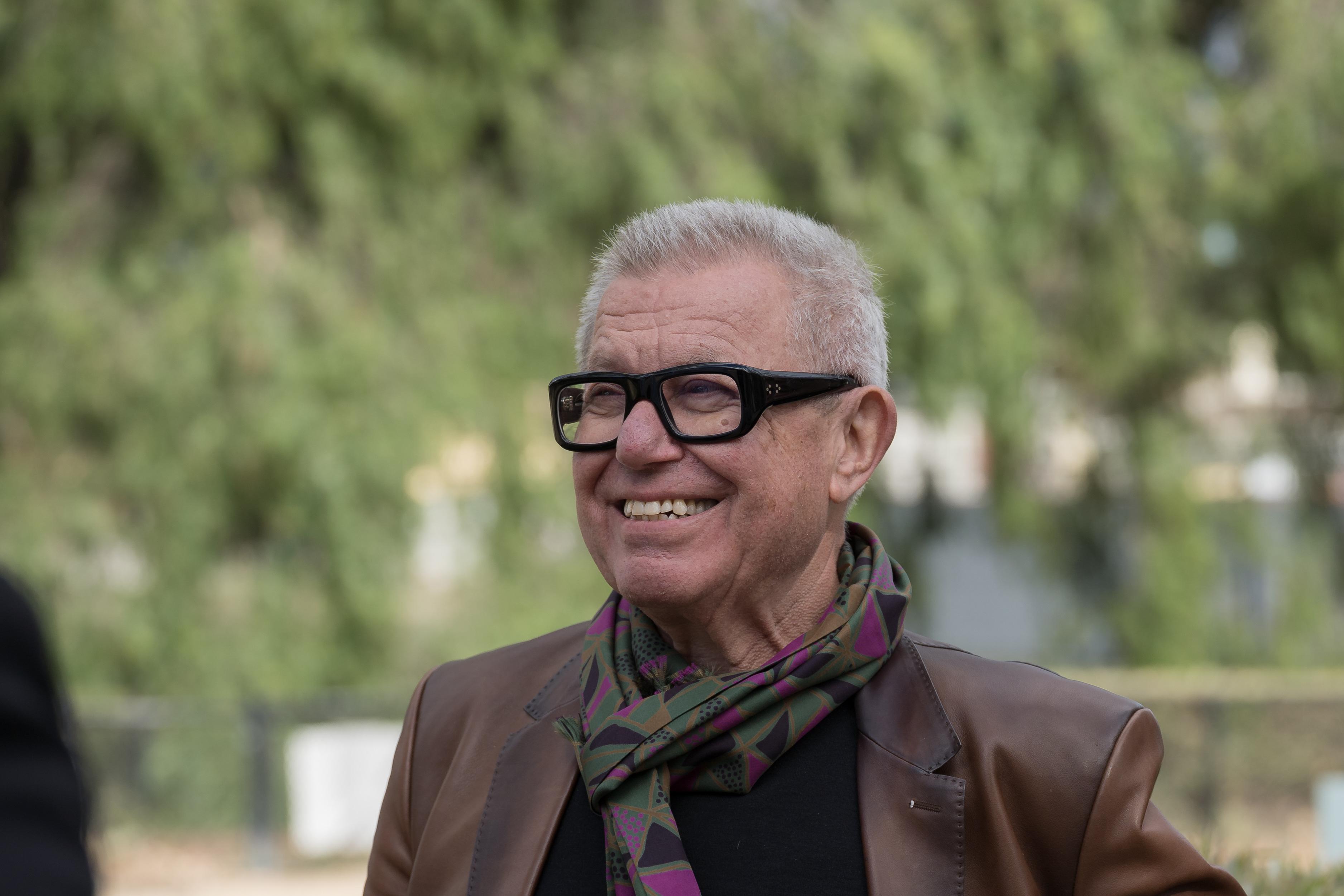
But architect Daniel Libeskind, who is designing Mount Scopus College’snew campus, says rising antisemitism makes a feeling of happiness and embrace even morecrucial to his plans for Mount Scopus College’s new school on a 7-hectaresite in Caulfield. He wants it to be open and joyful.[https://www.afr.com/politics/federal/police-say-home-attack-targeted-jewish-leader 20250911-p5mub0]
“[This] is just the right time to commission such a work because we haveto respond to it in positive ways,” says the New York-based Libeskind, whogained global fame for his zigzag design for the Berlin Jewish Museum thatopened in 2001. “We can’t respond to it by going into the shadows andburying our heads. We have to respond in creative ways.”
It’s a challenge to design a school and new Centre for Jewish Life inMelbourne’s south-eastern suburbs that teaches, respects and celebrates aculture and welcomes others while keeping people safe.
The project will combine three separate campuses at Burwood, St KildaEast and Caulfield, covering the full range of early learning to Year 12 intoone site on land previously used for stables and training facilities alongKambrook and Booran roads on the western edge of the Caulfieldracecourse.
Mount Scopus, one of Melbourne’s oldest Jewish schools, agreed to buy thesite from Melbourne Racing Club for $195 million in December, after adecade of planning. Construction will be staged, and the first facilities aredue to be operational by 2030.
This will be Libeskind’s first project in Australia to be realised. It’s not hisfirst Australian design – in 2018 he collaborated with Sydney firmFitzpatrick Partners to design a mixed-use precinct on the 3.5-hectare former HP site in Rhodes for developer Billbergia. That one never went ahead.
Libeskind, 79, doesn’t go into detail about the Mount Scopus design –which will be finalised in November – but says while based in education,the campus will be a facility and place of gathering for the widercommunity.
“That’s what we want to do – create a campus that is full of vitality, full offun,” he says over coffee at Melbourne’s Westin hotel.
“Let’s face it, the core of Jewish culture, in its deepest, is joy. It’s freedom.That’s what we celebrate. Every year in the Passover, we celebrate that weare free, that we are no longer slaves. So that’s the beauty of a campus thataffirms that core value of freedom, of democracy, of open society, of freethought.”
We meet at a time of rising extremism and polarisation, when the tragicIsrael-Gaza conflict has stoked a range of reactions – horror over Hamas’brutal October 7, 2023, attacks, criticisms of the State of Israel for thesuffering in Gaza, and increased antisemitism.
He’s done it before. He threaded that needle with his World Trade Centremasterplan for New York’s Ground Zero in 2003 – where half of the 16-acre(6.5-hectare) site is public space.
“We have, at Ground Zero, security concerns that stopped the project forone year,” he says. “But the idea was to create an open space, not a spacewith high walls. One beautiful thing about architecture is it providesstability. It’s a counter to the extremism.”
Libeskind knows antisemitism. He was born in Poland in 1946 toHolocaust survivor parents who denied him a piano as a childgrowing up because it was seen as “too Jewish” in postwar Lodz, the city inwhich he grew up.
“I took my music into an unexpected instrument. It’snot the accordion, it’s the world of building.”
“It was rabid antisemitism under the communist government,” he says.“My parents were too afraid to bring the piano through the courtyard.‘Jews have the money. They bought the piano’,” he says, describing thesentiment of his city at the time.
Instead, his parents bought him an accordion, and he became a childvirtuoso who found fame playing classical music on the accordion beforehe trained in design.
In 1959, two years after his family had emigrated from Poland to Israel, hewon a prize, the American-Israel Cultural Foundation Scholarship, playingBach’s Toccata in D Minor, a piece of music he still calls his favourite, onthe accordion.
“I was the only person with accordion,” he smiles. “There are hundreds ofpeople competing on the piano, on voice, on cello, violin, the tuba, the flute.No one was with accordion. I was the only one. I was 12 years old.”
Libeskind’s accordion-playing had a sell-by date, however, as one of thecompetition judges, late violinist Isaac Stern, told him.
“He took me aside right after I finished playing, and he put his hand on myshoulder and said, ‘You’ve already exhausted everything you can do in thisinstrument. You have to play the piano’. I was disappointed because I lovedplaying the accordion. So I drifted into architecture.”
The disciplines aren’t that different, he says. “Music andarchitecture are really inseparable because they say something toyou, but not in a way that you could just represent by words,” Libeskindsays, looking at me through his thick-rimmed black glasses.So I took my music into an unexpected instrument. It’s not the accordion,it’s the world of building. When you listen to a concert, to a beautifulmelody, it says something to you, just the way architecture says something.It’s not in words. It doesn’t tell you what it means. It speaks to your heart. Itspeaks to your soul.”
Despite Stern’s encouragement, he never got into the piano.
Back to the architecture. The former musician who callsarchitecture “the mother of art”, says the design – led locally by MGSArchitects, and which also includes firms Warren AND Mahoney,Freadman White and Aspect Studios – will create buildings and spacesthat permit many disciplines to flourish at Mount Scopus.
“That’s what architecture is,” Libeskind says. “It combines all theseseemingly contradictory interests: interest in science, interest in music,love for art. That’s where you know a child looking out of the window,looking, listening to the teacher will become the next Albert Einstein.”
So, will he be able to sell his clients on the vision? Not necessary, he says.
“My clients have that vision. I think my clients are well aware that theworld depends on a young person’s breath. The world doesn’t depend juston guns and bombs. It depends on a child’s imagination or a child’supbringing.”
And the key to this?
“The architecture has to be always open.”

Stay informed
Subscribe for updates about Project Generation.
Start a conversation
If you have a question, an idea to share or an interest in being involved, we’d like to hear from you.
